





FEATURES
Minimize cancellations and ensure smooth order fulfillment

Chat Types
1-1 chat
Group chat
Community chat
Live chat
Message Types
Text&Image message
Audio&File message
Location message
Short video message
Gifting message
Custom message
Emoji
Message Essentials
Send&Receive message
Historical message
Forward&Delete messages
Modify&Recall messages
Reactions
Message search
Typing indicators
Read receipt
Delivery receipt
Do not notify
Unread message counts
Mentions
Message translation
Chat Analytics
User&Group&Message count
Analytics dashboard
Data export
Restful API call
Moderation
Text&Image moderation
Domain moderation
Auto moderation
Violation interception
Custom review strategy
Mute & Ban user
Moderation dashboard
Push
Ordinary message push
All/tag users push
Online&Offline push
Custom jump interface
In-app Call
Audio/Video Call
Offline Push
Floating Window
AI Noise Suppression
Less Stutter Under Poor Network Conditions
Global Interconnectivity
USE CASES
Tencent RTC for on-demand marketplaces
- Delivery Services
- Ride-Hailing Services
- Rental Services
- Housekeeping Services
- AI-powered Customer Services

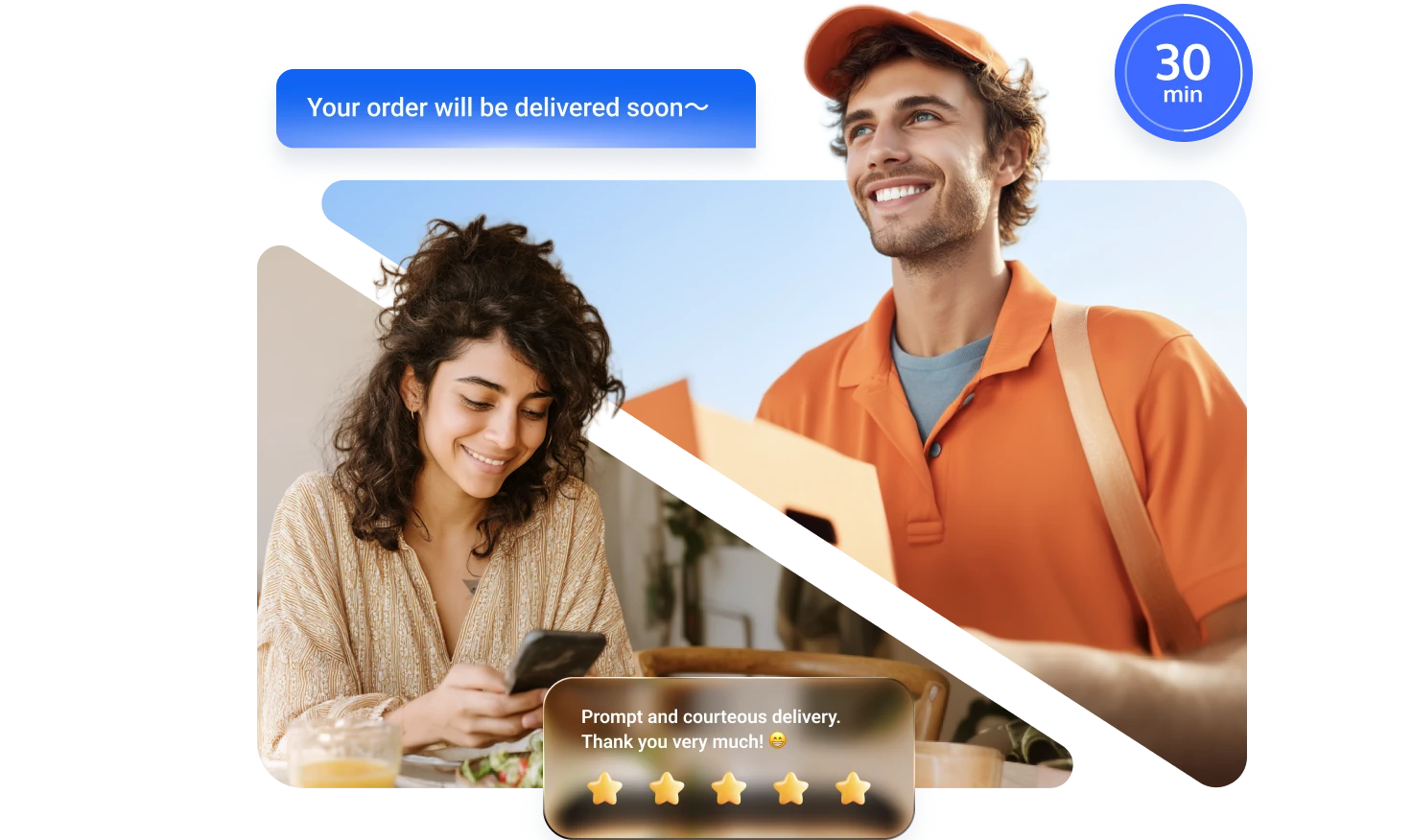
Facilitate real-time chat between customers, drivers, and merchants to ensure seamless delivery
- On-demand Delivery
- Order Status Updates
- Text/Image/Audio/Location/Video/message
- In-app Call
- Push Notification
Chat SDK&API connects customers and drivers, enabling instant communication to resolve issues, clarify instructions, and confirm drop-offs. This ensures a smooth and efficient order-to-delivery experience.

Use Chat SDK&API to make on-demand rides, carpooling, and scheduled vehicles more efficient
- On-demand Rides
- Live Location Sharing
- Text/Image/Audio/Location/Video/message
- In-app Call
- Push Notification
Efficient and secure communication is critical for ride-hailing services. Chat SDK & API allows drivers and passengers to communicate directly, protecting passenger privacy.

Facilitate direct messaging between tenants and landlords for property inquiries
- Multimedia Messaging
- End-to-end Encrypted Secure Chat
- Video Call Property Viewing
- Schedule a Viewing
Chat SDK & API connects landlords, agents, and tenants for direct communication, supporting remote property viewings via text, images, and video calls, eliminating the need to switch apps and avoiding delays.

Connect customers with service providers through in-app chat to clarify details before a appointment
- Rental/Moving/Repair/Cleaning/Pet Services
- Booking/Rescheduling Chat
- Text/Image/Audio/Location/Video/message
- In-app Call
- Push Notification
Chat SDK & API lets customers and service providers communicate directly to confirm service details and pricing, preventing misunderstandings and building trust from the start.

Provide instant, AI-powered support and a seamless handoff to a live agent for complex issues
- AI Chatbots Support
- Human Handoff
- Personalized Recommendations
- Context-aware Assistance
AI Chatbot quickly handles common questions 24/7 and passes complex issues to human agents, reducing wait times, improving experience, and cutting support costs.
PRODUCTS
Why is Tencent RTC essential for your on-demand Chat services?


Advantages
Advantages of the TRTC Chat API and SDK
From fast integration to global messaging, build secure and flexible chat experiences
Developer-Friendly
Integrate Chat into your existing app in hours with prebuilt UI components, templates, and developer-friendly SDK documentation.
Global Access
Enable stable cross-region messaging with a global network and multi-level optimal routing for real-time message delivery.
Multi-Platform Support
Build once across Android, iOS, Web, Flutter, React Native, and more with one message sdk built for cross-platform integration.
Free Forever
Start with 1,000 MAU free every month, no credit card required, perfect for early development, testing, and small-scale launch.
Security on Top
Protect messages and data with international data protection standards, SSL, AES encryption, and enterprise-grade security.
Flexible and Customizable
Customize your communicational experience with flexible UI, webhooks, plugins, and business extensions tailored to your product needs.
Customers
Trusted by leading enterprises worldwide
Chosen by over 100,000 enterprises, TRTC Chat SDK serves users across 200+ countries and regions

Ryt Bank
Ryt Bank is an entity established by YTL Digital Capital Sdn Bhd and Sea Limited, combining decades of industry expertise with cutting-edge digital innovation to bring the world’s first AI-driven bank.
Requirements
Ultra-low latency, seamless AI integration, reliable messaging, and security and compliance.
Solutions
Chat has independent IDCs in Singapore, Germany, India, Korea, and United States and deploys over 2,800 cache and access nodes in six continents to ensure reliable and real-time global messaging.
Chat offers flexible APIs, enabling Ryt Bank to directly integrate its multi-layer AI agents into the message stream, allowing AI to “listen,” “verify,” and “execute” in real time.
Chat is backed by 13 international compliance certificates and achieves over 99.99% service availability and message deliverability for Ryt Bank.

BeLive
BeLive Technology is a video SaaS company and a leading live streaming solution provider in Southeast Asia. It empowers brands and platforms to integrate live streaming and short video experiences, reaching over 100 million viewers with a cumulative playtime exceeding 50 million hours.
Requirements
Live social interaction, rapid deployment, high concurrency support, and global messaging.
Solutions
Chat provides BeLive’s live streaming business with audio/video chat rooms with an unlimited number of users, supporting rich social interaction features such as bullet chat, likes, and gifts for high-quality interactions.
Chat offers comprehensive low-code UI components compatible with Android, iOS, Web, Flutter, and React Native, significantly reducing development costs and enabling rapid feature deployment for enterprises.
Chat’s high-concurrency architecture supports dynamic scaling, allowing a single live streaming room to accommodate tens of millions of concurrent users.
Chat has independent IDCs in Singapore, Germany, India, Korea, and United States and deploys over 2,800 cache and access nodes in six continents to ensure reliable and real-time global messaging.

Amaze
The next-generation super app under Thailand’s CP Group combines a wide range of products with exclusive points, providing millions of users with a seamless shopping experience.
Requirements
E-commerce live streaming interaction, rapid deployment, high concurrency support, and reliable messaging.
Solutions
Chat’s high-concurrency architecture supports dynamic scaling, allowing a single live streaming room to accommodate tens of millions of concurrent users.
Chat has exceptional resilience against weak networks, maintaining a message delivery rate of over 99.99% even in complex mobile network environments.
Chat supports a wide range of real-time interactive features, including live comments, likes, gifting, product tags, coupon distribution, and real-time voting.

moomoo
A one-stop digital finance service platform launched by Futu for global investors. It integrates features such as trading, quotation, news, and social networking.
Requirements
Stock market trends monitoring, live streaming, in-app chat, reliable messaging, and security and compliance.
Solutions
With Chat server APIs, it can update stock prices in real time. moomoo users can chat with each other and fund managers with
Chat's one-to-one chat and live streaming features. moomoo uses customer service chat to engage users effectively.
Chat is backed by 13 international compliance certificates and achieves over 99.99% service availability and message deliverability for moomoo.

HABBY
Habby is a globally renowned game publisher headquartered in Singapore. It has released popular games such as Survivor.io, Archero, Mirage: Perfect Skyline, and Penguin Isle. Among them, Archero, a casual shooting game, became a worldwide sensation and entered the top 10 of the App Store download charts in 46 countries and regions.
Requirements
In-game chat, in-game group chat, and global messaging.
Solutions
With Chat, Archero players enjoy powerful chat features with diverse message types including text, emojis, and custom messages.
Chat brings Archero players who pursue shared interest together and lets them team up for battles. With group member profile feature, players' levels and badges can be easily displayed.
Chat has independent IDCs in Singapore, Germany, India, Korea, and United States and deploys over 2,800 cache and access nodes in six continents to ensure reliable global messaging.

Ryde
Ryde is Singapore’s first carpooling app and has now grown into a leading mobility platform offering comprehensive transportation and delivery services.
Requirements
In-app chat, reliable messaging, and Privacy and Security.
Solutions
Chat enables in-app messaging for Ryde, supporting various message types such as text, emojis, and custom messages, helping drivers and passengers interact on the platform with ultra-low latency, security, and seamlessness.
Chat is backed by 13 international compliance certificates,and uses SSL and AES encryption in its message transmission to protect user information and ensure privacy and security.
With over 20 years of experience in communication technology, Chat provides Ryde with more than 99.99% service availability and message delivery rate.

EF
Education First (EF) is a global leading education group specializing in language training, educational travel, degree programs, and cultural exchange. Currently, EF operates more than 600 English language schools in over 50 countries and regions worldwide.
Requirements
Live classroom interaction, member permission management, reliable messaging, and global messaging.
Solutions
Chat provides EF’s online classrooms with a Chat API that supports various message types, including text, images, and custom messages. Students and teachers can interact in real time during class, and can also upload courseware, handouts, and other content at any time, enhancing the effectiveness of teaching.
EF uses Chat's signaling management feature to implement classroom management capabilities such as managing students’ microphone access (on/off), muting all participants, inviting students to join, raising hands, and more.
Chat has independent IDCs in Singapore, Germany, India, Korea, and United States and deploys over 2,800 cache and access nodes in six continents to ensure reliable global messaging.
Ensure privacy and information security
Power messaging for millions of users and thousands of customers on our highly scalable infrastructure, built for security and reliability and certified by leading compliance standards.
Data at Rest
Protected by AES 256 Encryption.
Data Privacy
Enhanced by end-to-end Encryption.
Data in Transit
Protected by SSL/TLS.













Frequently Asked Questions
What is Tencent RTC Chat SDK?
Tencent RTC Chat SDK is a development toolkit for in-app messaging scenarios, providing SDKs, APIs, and pre-built UI components that enable developers to quickly integrate one-to-one chat, group chat, message sending/receiving, and group management capabilities. For business scenarios requiring deep customization, developers can also use the Core SDK to customize chat logic and combine it with real-time interactive capabilities such as voice and video.
How does Tencent RTC compare with other products?
Tencent RTC Chat SDK provides pre-built UI components, Core SDK, and MCP integration capabilities, supporting rapid integration and deep customization to help developers reduce integration costs and accelerate time-to-market. Under specific laboratory testing conditions, Chat SDK maintains stable message delivery performance even at up to 60% packet loss rates. It also offers a free tier of 1,000 MAU per month, suitable for development, testing, and early-stage launch.
How do I integrate Tencent RTC Chat SDK?
Tencent RTC provides three integration approaches:
MCP Integration: Suitable for AI-assisted development, quick trials, and demo building. Initialization, configuration, code generation, and testing can be completed through natural language interaction.
UIKit Integration: Suitable for rapid launch and moderate customization. Provides out-of-the-box chat UI across multiple platforms, with support for customizing themes, layouts, and interactions.
SDK Integration: Suitable for complex businesses and deep customization. Provides full API capabilities and can be deeply integrated with AI, audio/video, and other capabilities.
Which development platforms does Tencent RTC support?
Tencent RTC Chat SDK supports 7 major platforms: iOS, Android, Web, Flutter, React Native, Unity, and Unreal Engine, while also supporting cross-platform frameworks such as Electron and uni-app. Each platform provides an out-of-the-box UIKit component library, including modules for conversation lists, chat windows, and contact management. In addition, Tencent Chat can be easily integrated using MCP.
Is Tencent RTC compliant with HIPAA requirements?
Yes. Tencent RTC Chat is HIPAA certified and can provide customers with a BAA (Business Associate Agreement). In addition, Tencent RTC Chat has passed 13 international security certifications including SOC 1/2/3 and ISO 27001, meeting strict data security requirements for healthcare, financial services, and other highly regulated industries.
Is Tencent RTC Chat SDK permanently free?
Yes. Tencent RTC Chat offers a free tier that includes 1,000 MAU per month. Developers can start using it without binding a credit card. The free tier includes push notification capabilities and supports usage alerts to help developers manage their usage more clearly.
Can Tencent RTC support large-scale concurrency?
Yes. Tencent RTC Chat processes over 550 billion messages per day at peak, supports 100,000+ concurrent members in a single group, and has proven elastic zero-downtime scaling from 10,000 to 2,000,000 concurrent users in production environments. Under extreme laboratory conditions with 60% packet loss, message delivery success rate remains at 100%.
Does Tencent RTC provide AI capabilities?
Yes. Tencent RTC Chat provides multiple AI capabilities covering scenarios such as development integration, content safety, real-time translation, and intelligent interaction:
MCP Integration: Supports completing project initialization, configuration, code generation, and testing with AI assistance.
AI Content Moderation: Supports moderation of text, images, and video content, helping reduce manual review workload.
Real-time Translation: Supports multi-language message translation, enabling smooth communication across language barriers.
AI Chatbot Integration: Supports connecting custom bots for scenarios such as auto-reply and intelligent customer service.
Intelligent Message Recommendations: Can combine user behavior and business rules to support more personalized message delivery.
How is Chat SDK priced? Is there a free trial available?
Yes, we provide a free trial including up to 1,000 MAU, allowing you to fully experience all features of our Chat SDK product. For continued use, Tencent RTC services follow a combined billing model: a prepaid monthly subscription as the base, with pay-as-you-go charges for excess usage. For detailed pricing information, please refer to our pricing page.
How can your Chat SDK be combined with other products?
The Tencent RTC Chat SDK can be seamlessly integrated with other products like Call and Live through a unified console that allows multiple services to be managed under a single application. This shared application infrastructure enables powerful interoperability for use cases such as adding real-time chat to a live stream or messaging within an audio/video call. This is further supported by the framework-agnostic Chat SDK, which can be combined with other product SDKs in the same app, as seen in common workflows like using the Chat SDK and Room SDKs together for meetings or combining the Chat SDK and Live SDKs for interactive streaming. While services may require separate billing packages, they are managed under a unified billing center.
What types of applications can I build with Tencent RTC Chat SDK?
The Tencent RTC Chat SDK is highly flexible and empowers you to create various types of chat or messaging applications, including but not limited to one-to-one messaging, group chats, live streaming interactions, and short video platforms, where you can follow celebrities, join live groups, and post comments. Additionally, it supports features like message forwarding, recall, quote, and read receipts, making it suitable for fully-featured chat apps.
How do I choose a chat API for in-app messaging?
Compare the platforms, conversation model, authentication and interface work your app needs. Prototype two authenticated users before deciding between a Core SDK and connected UI components.
Can a chat API connect customer support and community conversations?
Use different access and membership rules for service threads and public groups. Your backend owns support workflows and community policy; the messaging layer carries the conversation.