





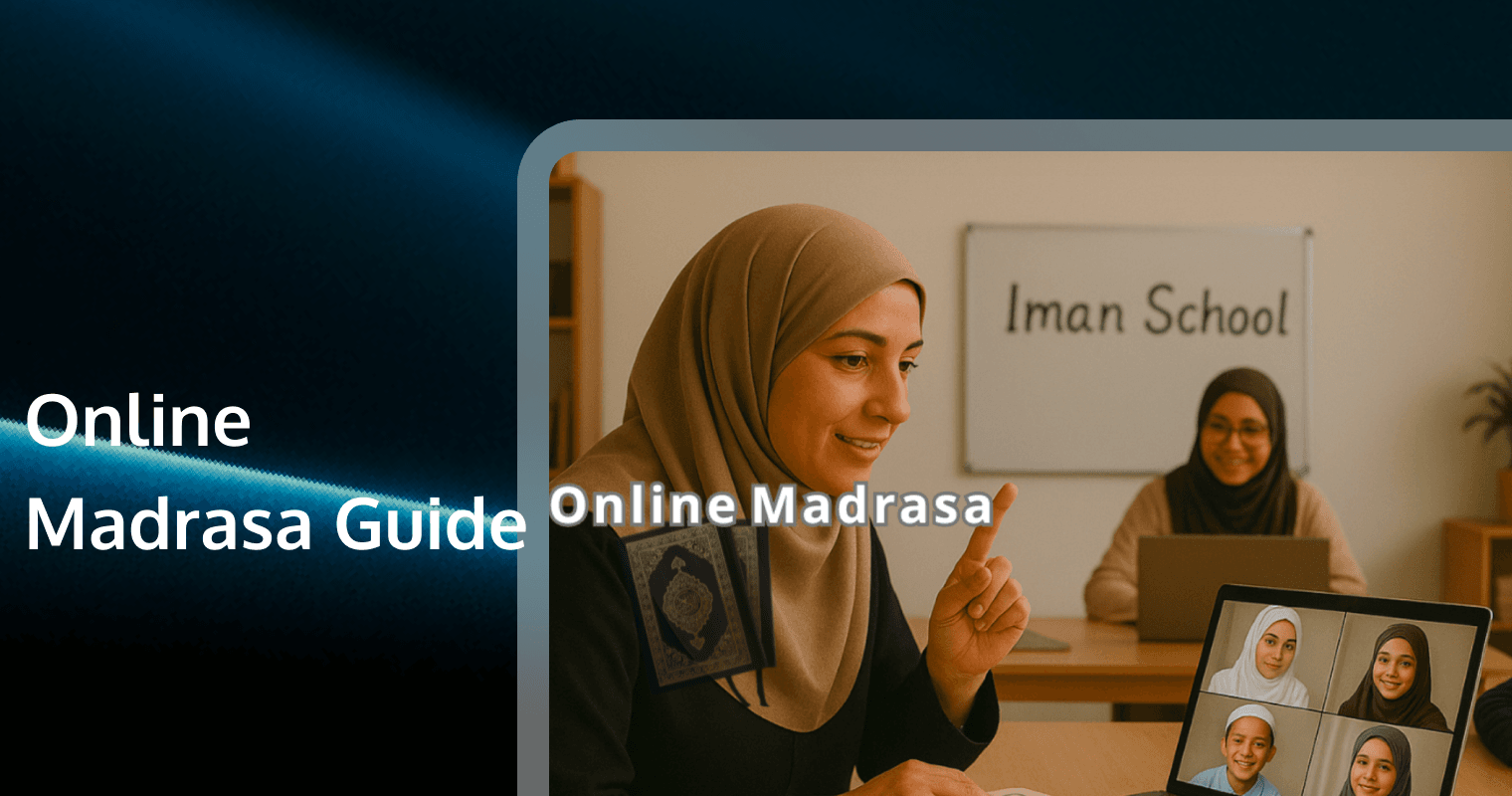
For over a millennium, the Madrasa has been the beating heart of Islamic preservation. From the grand arches of Al-Azhar to the humble neighborhood maktab, these institutions have safeguarded the transmission of knowledge (Ilm) from chest to chest. However, the 21st century has introduced a paradigm shift. The Online Madrasa is no longer just an alternative for those living in remote areas; it has evolved into a sophisticated, primary ecosystem for Islamic education.
Whether you are a parent seeking the best education for your child, a student of knowledge, or an educator looking to digitize your institute, this comprehensive guide will dismantle the complexities of the digital madrasa. We will move beyond the basics of "Skype classes" and explore the high-fidelity, structured, and pedagogical innovations defining the future of Islamic EdTech.
1. The Evolution: From Traditional Maktabs to Digital Classrooms
The transition from physical to digital is not merely a change of medium; it is a transformation of methodology. To understand the Online Madrasa, one must first understand what it attempts to replicate—and where it aims to improve.
The Traditional Model vs. The Digital Model
Feature | Traditional Madrasa | Online Madrasa |
Student Ratio | 1:25 (High crowd, low focus) | 1:1 or 1:5 (Hyper-focused) |
Pedagogy | Rote memorization, group chanting | Visual aids, digital whiteboards, AI tracking |
Accessibility | Hyper-local (depends on neighborhood) | Global (Access to scholars in Egypt/Madinah) |
Discipline | Physical presence, strict supervision | Self-discipline, parental involvement required |
Audio Quality | Natural acoustics | Dependent on RTC Technology (Crucial for Tajweed) |
The Three Tiers of Online Madrasas
Today's market is segmented into three distinct categories:
1. The Marketplace (Aggregators): Platforms like Preply or Italki tailored for Quran tutors. These are unstructured; you hire a freelancer. Quality varies wildly.
2. The Virtual Institute: Established organizations with a set curriculum, exams, and administration (e.g., Mishkah, Bayyinah). They operate like a school but strictly online.
3. The Hybrid/Blended Maktab: Local mosques that use digital tools for homework, revision, and advanced classes while maintaining weekend physical meetups.
2. Anatomy of a High-Quality Online Madrasa Curriculum
A common misconception is that online madrasas only teach Reading. A elite online madrasa offers a holistic curriculum that rivals physical seminaries. If you are evaluating a school, look for these structured pillars.
Pillar A: The Quranic Sciences (Ulum al-Quran)
Nazira (Reading): The foundation. Uses digital Qaida* with interactive audio examples.
● Tajweed (Articulation): The science of pronunciation. This requires high-fidelity audio (more on this later) to detect the difference between a 'Heavy Ha' and 'Light Ha'.
Hifz (Memorization): Uses "spaced repetition" software to manage revision schedules, ensuring old portions (Manzil) are not forgotten while new portions (Sabaq*) are memorized.
Pillar B: The Islamic Sciences (Shariah)
● Fiqh (Jurisprudence): Taught using case studies relevant to modern life (e.g., Fiqh of Social Media, Fiqh of Finance).
● Aqeedah (Theology): Logical proofs and foundational beliefs, often taught using mind maps and presentation slides.
● Seerah (History): Interactive timelines of the Prophet's life, rather than dry lectures.
Pillar C: The Arabic Language
● Moving beyond recitation to comprehension.
Methodology: Modern online madrasas use the Medina Books or Arabiyyah Bayna Yadayk* series, adapted for screen sharing with interactive fill-in-the-blank exercises.
3. The Pedagogical Difference: How Online Islamic Teaching Works
Teaching online requires a different skillset than teaching in a mosque. The "baraka" (blessing) of physical presence is replaced by the efficiency of digital focus.
The "Virtual Knee-to-Knee" Technique
In Islamic tradition, knowledge is passed knee-to-knee. Online, this is replicated through Video On policies.
● Lip Reading: The teacher must see the student's mouth to correct Tajweed (e.g., lip rounding on 'Damma').
● Eye Contact: Ensuring the student isn't distracted by another tab.
Gamification of Muraja'ah (Revision)
Traditional revision can be tedious. Online platforms use gamification:
● Leaderboards: Who recited the most pages this week?
● Badges: Unlocking the "Juz 30 Master" badge.
● Streak Counters: Encouraging daily logging in, similar to Duolingo.
4. Step-by-Step Guide: Choosing the Right Institute for Your Family
With thousands of options, how do you vet a legitimate provider? Use this 5-step auditing process.
Step 1: Verify the Sanad (Chain of Transmission)
Does the organization have a scholarly board? Do the individual teachers hold an Ijazah (license) linking them back to the Prophet (PBUH)?
Red Flag: "Certified Tutor" without specifying who* certified them.
Step 2: Audit the Technology
Ask for a trial class. During the trial:
● Is there a lag? (Latency > 200ms destroys recitation flow).
Is the audio crisp? Can you hear the whisper attributes (Hams*) of letters?
● Do they use a dedicated Learning Management System (LMS) or just WhatsApp?
Step 3: Check Child Safety Protocols
● Recording: Are all classes recorded for parental review?
● Background Checks: Are tutors vetted for safety?
● 2-Deep Leadership: Does a supervisor randomly drop into classes?
Step 4: Curriculum Transparency
Ask: "If my child starts today, where will they be in 3 years?"
● A good madrasa will show you a syllabus roadmap (e.g., Year 1: Qaida + 10 Surahs; Year 2: Juz 30 + Fiqh of Prayer).
5. Technical Requirements: Ensuring Crystal Clear Recitation
The biggest bottleneck in online madrasas is technical limitation. Tajweed is an auditory science. Standard "Chat" apps often compress audio, removing the subtle frequencies needed to distinguish letters.
The Hardware Setup
● Headset: Essential. Noise-canceling headphones with a boom mic prevent echo and isolate the student's voice.
● Camera: A 1080p webcam positioned at eye level. The teacher needs to see the throat and jaw movement.
● Internet: A wired Ethernet connection is superior to Wi-Fi to prevent "jitter" (choppy voice).
The Software Expectation
Parents should prioritize platforms that support High-Fidelity Audio.
Frequency Response: Standard calls cut off at 8kHz. Tajweed recitation needs full-band audio (up to 48kHz) to capture the breathiness of letters like Ha (ح) and Kha* (خ).
6. Overcoming the "Tarbiya" Gap: Instilling Manners (Adab) Virtually
Critics argue online madrasas fail at Tarbiya (moral upbringing). While you cannot transmit character through WiFi, you can structure it.
The Digital Adab Protocol
● Dress Code: Students must dress as if they are going to the Mosque (Covered Awrah, Wudu ready). This psychologically prepares them for sacred knowledge.
● Virtual Etiquette: entering the "room" with Salam, not eating during class, sitting respectfully.
● Parental Proxy: In an online setting, the parent must become the "Monitor of Adab," enforcing the discipline that the teacher cannot physically enforce.
7. For Educators: Building a Scalable Online Madrasa Platform
If you are an educator or entrepreneur planning to launch an online madrasa, do not rely on generic meeting apps. You need a purpose-built infrastructure.
The Tech Stack
1. LMS (Learning Management System): To track attendance, grades, and payments (e.g., Moodle, Thinkific).
2. Scheduling Engine: To handle time-zone conversions automatically.
3. Real-Time Classroom: The core engine. This is where the learning happens.
Why "Generic" Video Apps Fail Madrasas
● Latency: When two people recite together, latency creates a "clash." You need ultra-low latency (<200ms).
● Privacy: Many generic apps sell data or lack encryption.
● Lack of Tools: You need a digital whiteboard that overlays on the Quran text, allowing the teacher to circle Tajweed rules in real-time.
8. Enhancing Online Madrasa with Real-Time Communication
To build a truly elite Online Madrasa, the quality of the Real-Time Communication (RTC) is the single most critical factor. This is where Tencent RTC becomes the industry standard for educational platforms.
Why Tencent RTC for Islamic Education?
Islamic education is unique because it requires Lip Synchronization and High-Fidelity Audio. If the video lags behind the audio, the teacher cannot correct the articulation points (Makharij).
Tencent RTC provides specific solutions that solve the "Madrasa Problems":
1. Crystal Clear Audio (Full-Band):
The Problem: Standard Chat SDKs compress audio, making Seen (س) and Saad* (ص) sound the same.
The Solution:* Tencent RTC's Voice Chat Room and Audio SDKs support 48kHz full-band sampling. This captures the full spectrum of the human voice, ensuring every nuance of Tajweed is audible.
2. Ultra-Low Latency for Recitation:
The Problem:* In a class, if a teacher interrupts to correct a mistake, a 1-second delay causes confusion.
The Solution:* Tencent RTC's Video Call capabilities offer end-to-end latency as low as 300ms globally, allowing for seamless, interruptible interaction closer to a real-life conversation.
3. Interactive Whiteboard & Screen Sharing:
* With Tencent RTC's Conference solutions, developers can integrate screen sharing directly into the app. A teacher can display a PDF of the Quran, highlight a verse in red, and the student sees it instantly without pixelation.
4. Global Connectivity for Global Scholars:
* Online Madrasas often connect students in the UK/USA with scholars in Egypt or Pakistan. Tencent's massive global infrastructure ensures stable connections even in regions with fluctuating internet speeds.
Recommended Products for Madrasa Developers:
● Tencent Real-Time Communication (TRTC): For the core video/audio classroom.
● Instant Messaging (IM): For student-teacher chat, homework submission, and class announcements.
● Cloud Recording: To automatically record lessons for student revision and parental monitoring.
By integrating Tencent RTC, you transform a glitchy video call into a professional, sacred learning environment.
9. Frequently Asked Questions
Q1: How do I ensure the audio quality is good enough for Tajweed correction?
A: Audio quality depends heavily on the platform's underlying technology. We recommend platforms built with Tencent RTC, which supports high-fidelity, full-band audio (48kHz). This ensures that subtle differences in letter articulation are clearly transmitted and not lost in compression.
Q2: Can I build my own Online Madrasa app instead of using Zoom?
A: Yes, and you should for a branded experience. You can use Tencent RTC's Video Call SDK to quickly integrate professional video and voice capabilities into your own custom app. This gives you control over the user interface and features like digital whiteboards.
Q3: How do we handle different time zones for students and teachers?
A: A custom platform is best for this. By using Tencent RTC's Instant Messaging (IM) APIs, you can build automated notification systems that alert students and teachers of class times in their local time zones, ensuring no one misses a session due to confusion.
Q4: Is it possible to record classes for child safety and revision?
A: Absolutely. If you build your platform with Tencent RTC, you can utilize their Cloud Recording feature. This automatically saves video and audio streams to the cloud, allowing parents to review lessons later and students to practice alongside their teacher's recording.
Q5: What if my student has a slow internet connection?
A: Connectivity issues are common in global education. Tencent RTC is designed with excellent weak-network resistance. It adapts the video quality in real-time to prevent the call from dropping, ensuring that the audio (the most important part for Quran) remains stable even if the video quality dips slightly.